Sunday, August 20, 2023

Flexibility in Lesson Planning.

Hello everyone! Welcome once again to my blog for the week 08/10/23. 

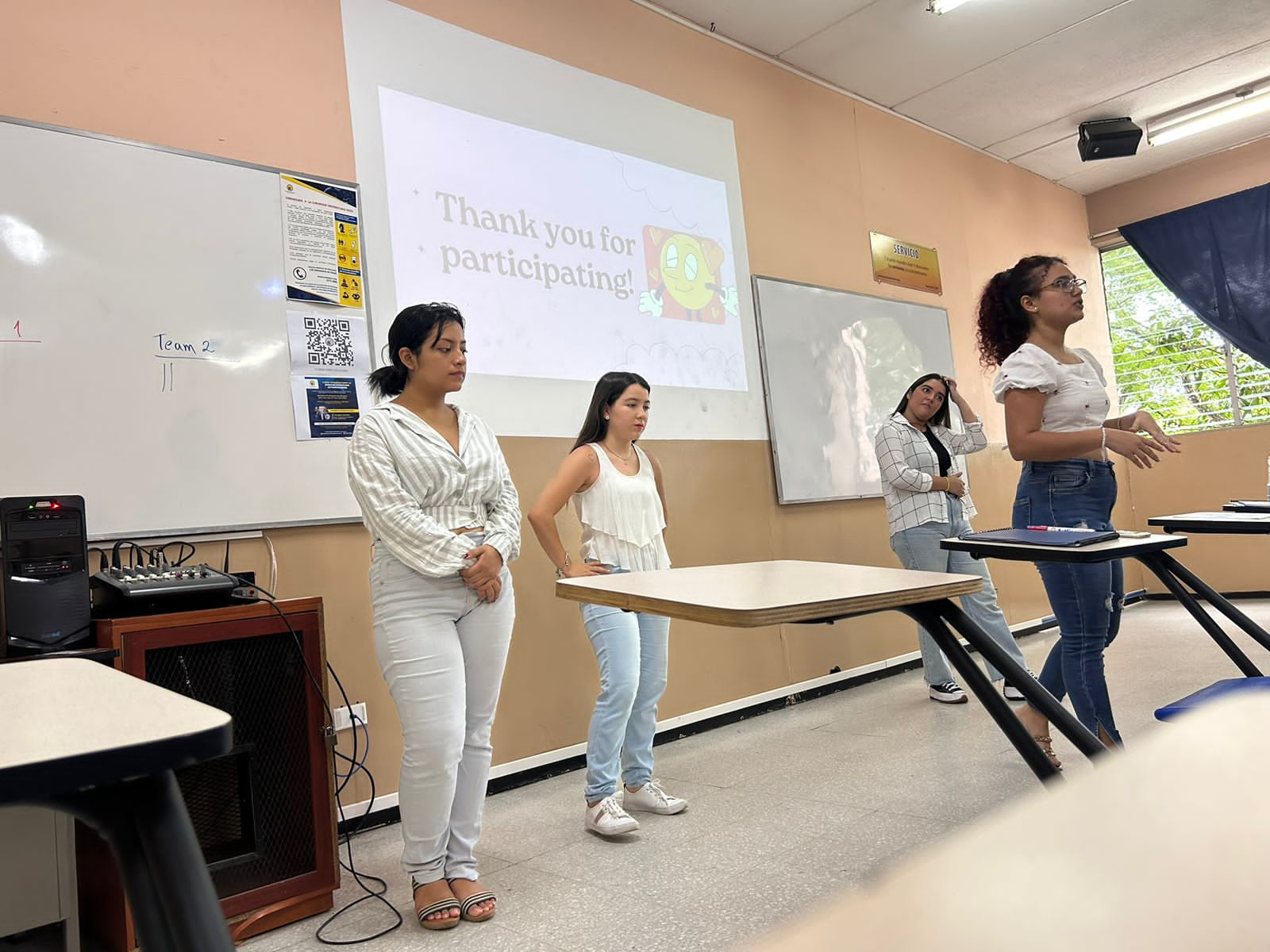
First of all, that day we had been asked to arrive half an hour early, as Miss Brendaly had requested our help to participate in some activities that other students in the major had to do. So I had to leave work a little early, but I arrived on time and decided to participate. 

I remember we first scanned a QR code to fill out a general survey. Then a few of us went on to do a sight translation practice. The text was about artificial intelligence and its impact on society. Honestly, it had been a while since I had practiced this type of translation, but I think it went well. 

After that, we had a meeting with Regina, who is also a student, but unlike us, she already has a lot of experience in the field. Then she taught several very interesting topics that allowed us to learn more about this business area. What I remember is that the companies she recommends are AIIC, ATA, AGIT and USAID. We can quote interpreting equipment with Komunicare and Signify. An estimated charge for translations would be $25/$30 per page or 10/15 cents per word. For a quote we must take into account personal budget, client payment, and payment schedule. And I actually forgot to take pictures about this. 

Then, Lic Orlando started the class. We talked about "Magic moments/topics" which are those that everyone wants to talk about. 


We have to keep in mind that everything we teach has to be according to the student's level. (Realistics scenarios)

The objective and the production must always match.

Lesson planning, its like a recepe. We have to make sure it takes us to the fianl objective. 


Here is Lic Orlando showing us his crazy watch. 


Monday, July 31, 2023

Activities in the classroom

Hello everyone! Welcome again to my blog. 😀

We started by talking about our previous class, which was about lesson planning. It is important to know that a lesson plan can also look like an agenda and should have a main objective. 

We also talked about how to write an objective for lesson planning. Teaching and lesson planning require a lot of observation. Sometimes, when we teach how to teach, we realize that we may not set the best examples as teachers.

Then, we discussed about which activities we can do for some scenarios: .

* Activities to group people

Name tags can help group people together so that students can share with other students who are not their friends. We can also group people by their clothing color, their initial letter, etc. 


We can also use objects for students to pass around and when the song stops that person becomes part of a group, or use something like this magic hat to pick out name tags. 


* Activities to measure time 

To measure time, we can simply use an online stopwatch, play some music and stop it, counting numbers, etc. 

* Activities to promote participation

For this, we can also use objects. Teacher Orlando used 2 different objects and gave them to 2 students who were on different sides of the classroom. Then, he made sounds with the board so that they started to pass them to the others. When he stopped, the student with object 1 had to ask a question and the other student had to answer it. It was fun because of the excitement of passing it out in time. 


* Activities to make sounds for classroom dynamics 

The most common example is clapping for a specific amount of time for a specific objective during class. 

* Activities to wake students up when they're falling asleep.

We can randomly ask students a specific question about the topic to make sure they are paying attention. We can ask them to stand up and discuss the topic or what they learned in the previous class, etc.  

* Activities for praising students, etc.

For this, I consider that giving a compliment is essential, letting them know when they have done something well, congratulating them for small improvements, or if possible we can give them candy for answering something correctly, etc. 

At the end of the class, we sang happy birthday to Miriam, as it was her 23rd birthday. And teacher Orlando did another activity, in which he gave out the objects again and the person who got them had to say something good about Miriam. I was one of the chosen ones, but my nerves played a trick on me and I couldn't say many things, lol. 


So, that would be all for this entry. See you after vacations!

Wednesday, July 26, 2023

Lesson planning, CCQs & ICQs

 Hello teacher and everyone!

This week's class was different as it was virtual. In fact it reminded me of the pandemic times when all the activities were like this. So yes, I did miss attending face-to-face classes last week. However, our teacher is so dedicated to his work that he left us with several activities that I could not finish.😅

We studied about lesson planning and the importance of it. It is important to calculate the duration of the class, the steps to take, what activities to do according to the topic taught, otherwise we could fall into the error of improvising, which would lead us to a class without coherence. 

An important point that caught my attention was to anticipate the possible problems that students may face and to know how to solve them in case they arise. 

Then, we had to talk about this topic in a Vocaroo video and give our opinion. In my case, I could not do it on Thursday, but only until last Monday, with just a couple of hours left. 😅

Afterwards, we used another platform called Padlet Wall, where we answered a couple of questions, of which the first ones were a bit personal, so I answered them honestly, trusting that no one would have enough time to read it. In fact, I don't think I ever read anyone else's participation, I barely have enough time to make my participation. 😂

Lastly, we had a third activity to record another video. Unfortunately I was unable to complete it due to time constraints. But it was about ICQs and the CCQs. 

CCQ stands for Concept Checking Questions and ICQ stands for Instruction Checking Questions. 

Monday, July 17, 2023

English Didactic II

Hello, everyone. Welcome to the first entry of this semester. I am so glad that teacher Orlando is still with us, as it would have been much harder to get used to another teacher, so I am excited to continue learning and putting my knowledge into practice. 

For our first class, we had a pop quiz, which I obviously wasn't prepared for😂, I only got 3 or 4 answers correct, and I didn't remember the rest. Here is a picture of it:


Sorry the paper looks like this😅, I thought we were supposed to participate only in the forum and that's why I didn't take pictures in the classroom either, but I will next time. 

We also reviewed how the syllabus and evaluations will be during this semester. We will start teaching soon and the most interesting thing is that we will have to bring students from outside the university who want to learn more; no matter their english level, sex, age, well they must be at least 18 y/o and they will have to go every Thursday and at the end they will receive a recognition. I really like the idea, I still don't know if I will bring someone but I am sure it will be great.

So, stay tuned for the next entry! See you.✌

Sunday, June 4, 2023

Demonstrations


Welcome to my last entry😭

This entry is about our last activity, where we did groups; each group had to explain different activities for listening, speaking, writing and reading, just like a normal class, so this time we became teachers.

Here is the Fernando´s group, that it was about listening.


They gave us some general details and tips. 

At the end, they asked us to listen to a song, they gave us the lyrics on pieces of paper and we had to order the lyrics according to what we were listening to, although I already knew the song, it still wasn't too easy since it was a rap.


Here it should go my group, but I don´t have any photo from that day😟

We did three speaking activities, from basic to advanced level. First, Aby did a spelling bee, in which she divided two groups, then she went around saying the words and the group with the most correctly spelled words was supposed to win. Then, in my activity, I implemented the Modal Verbs, so that they could give me suggestions to particular scenarios, the funny thing is that I gave each participant only 15 secods to say as many examples as possible. Then, Rodrigo, also had two groups, he showed them an image without context and they had to create a story, one had to start it, the next one continued it and the last one gave it an ending. I really liked all 3, as our classmates had to work very hard to successfully complete these speaking activities.

Afterwards, we had the reading group. 


They gave us very good advices and asked us if we liked to read, what disinterested us while reading or what distracted us.

Then, we were asked to read an article, which was somewhat complex, and that was the idea, to read something that not many people were interested in, to identify if we could understand the topic and so on. Then we did a word search game, which I really liked, although it had some errors in some words. 


Then, we had the writing group.


First, we completed these sentences.


Then we did some grammar exercises, in which we were told that we could use some conjunctions, such as coordinates, subordinates, comparatives, etc., to improve our composition.


Here is the structure of a letter:

And my example of a thank you letter:

Then, unfortunately, in Tuesday's class I was unable to attend, but I asked my classmates to send me some photos from that day. Here are the 4 remaining groups:


Overall, it was a good semester, and this subject definitely exceeded my expectations, as I mentioned in my final test, I never thought of becoming a teacher until I studied English Didactics. I can only say thank you teacher for being so passionate in what you do, for transmitting us that energy, and for giving us your example as an excellent teacher.


Teaching Receptive Skills

 Welcome everyone to another blog's entry! 

Receptive skills refer to the ability to understand and comprehend spoken or written language. These skills include listening and reading comprehension. Teaching receptive skills is important for students to be able to communicate and interact effectively with others.

To teach receptive skills, it is important to create a conducive and engaging learning environment. This can be achieved by using a variety of teaching strategies, such as authentic materials, interactive activities, and differentiated instruction.

Listening comprehension is an essential skill for effective communication. To teach listening comprehension, it is important to use authentic materials such as videos, podcasts and songs. These materials expose students to real-life situations and help them develop their listening skills.

Interactive activities such as role-plays, group discussions and listening games can also be used to make the learning experience more engaging and fun. In addition, if learners receive feedback on their listening skills, they can improve and increase their confidence.

Teaching Reading Comprehension

Reading comprehension is another important receptive skill. To teach reading comprehension, it is important to use materials appropriate to the level and interests of the students. These can be authentic materials, such as newspaper articles, stories and novels.

Interactive activities, such as reading circles, summarizing exercises and discussion groups, can also be used to encourage engagement and comprehension. In addition, teaching students strategies such as skimming, scanning, and predicting can help them become more efficient readers.

Differentiated Instruction in Receptive Skills

Differentiated instruction is an important approach to teaching receptive skills. It involves tailoring instruction to the individual needs and abilities of each learner. To do this, teachers can use a variety of strategies, such as flexible grouping, tiered tasks, and a variety of instructional materials.

Through differentiated instruction, teachers can ensure that all students feel stimulated and engaged in the learning process. This approach can also help students develop their receptive skills at their own pace and in a way that best suits them.

Assessment of receptive skills

Assessment of receptive skills is important to determine the progress of learners and identify areas in which they need improvement. This can be done through a variety of assessment methods, such as questionnaires, tests, and performance tasks.

It is important to use a variety of assessment methods to gain a comprehensive understanding of learners' receptive skills. In addition, providing learners with feedback on their performance can help them understand their strengths and weaknesses and guide their learning.

What makes a passage easy or difficult?

In general, listening texts are easier if:

  1. They are fairly short.
  2. They have one or two easily distinguishable speakers.
  3. The speaker speaks slowly (yet naturally), with a standard accent.
  4. You can hear the speaker well. 
  5. The topic is familiar. 
  6. The structure of the text is simple and straightforward. 
  7. The students are interested and prepared for what they are about to hear.
On the other hand, reading texts are easier if they:
  1. They contain simple language
  2. Are short
  3. Contain simple sentences
  4. Are clearly organized
  5. Are objective
  6. In standard English 
  7. The subject matter is concrete and familiar
  8. Are supported by layout, headings, images, graphics, etc.
In conclusion, teaching receptive skills is essential for learners to communicate and interact effectively with others. Teachers can help learners develop their receptive skills by creating a supportive and engaging learning environment, using authentic materials and interactive activities, providing differentiated instruction, and assessing learner progress.

Ultimately, teaching receptive skills is about enabling students to become effective communicators and lifelong learners.

Sunday, May 28, 2023

Teaching Speaking

 Hello! Welcome back to another entry👽

I was looking for photos from this class, but honestly I didn't find any on my cellphone, apparently I didn't take photos😢 

However, here it is a summary about teaching speaking by Jeremy Harmer, in which we discussed about some activities, such as, role playing, simulation, and real play.  

Dimensions of Speaking

1.      Transactional or Interpersonal

2.      Interactive or Non-interactive

3.      Planned or Unplanned

Ex: A Job Interview à largely transactional, interactive, and planned.

The roles of the teacher in a Speaking Lesson

·        Prompter


·        Participant

·        Feedback Provider 


It is recommended to introduce the functional language at the beginning of the speaking class. In this way, students will be able to use it successfully later in the class.


Last Entry Groups 7 & 8 (Nov 9th)

Welcome to my last Didactics II entry. I have to admit it, but I feel a little sad that everything has come to an end, especially this class...